

Business
Insurance Without a Safety Net? Canadian Firms Face Premium Hikes Amid Cyber Liability Crisis

Toronto, ON —
July 4, 2025 — As ransomware incidents and data breaches continue to spike across Canada, many mid-sized firms are now finding themselves priced out of the very protection they need most: cyber insurance.
According to a new report from the Maple Risk Institute, premiums for cyber liability coverage in Canada have risen by an average of 41% year-over-year, with some sectors — including legal services, logistics, and private healthcare — seeing even steeper increases or flat-out denials.
“Insurers are spooked,” said Arjun Patel, a senior risk analyst at Maple Risk. “Claims are skyrocketing, and the underwriting models weren’t built for this volume or complexity of cyber incidents.”
One major driver, Patel says, is a wave of quiet ransomware settlements, particularly after last year’s high-profile breach at Regal Processing Group, a national payroll processor that reportedly paid a seven-figure ransom to avoid a class-action lawsuit from affected clients.
“The insurers paid out quietly, but now they’re passing those losses straight down the chain,” he added.
A Shrinking Pool
Of the 12 major insurers that offered cyber liability coverage in Canada in 2022, only seven are actively writing new policies today, and many have added stringent preconditions, including mandatory penetration testing and proof of MFA enforcement across all endpoints.
“For a lot of companies, especially outside urban tech hubs, these conditions are unrealistic,” said Tara Muir, COO of logistics firm NorthTrak Freight. “We’re being told to upgrade our security stack or be denied coverage — but we can’t afford the upgrades without the coverage.”
A Risk Spiral in Progress
Experts warn that without accessible insurance, smaller firms may choose to underreport or hide breaches, leading to downstream damage in interconnected supply chains and customer networks.
“The cyber risk spiral is real,” said Patel. “Less coverage means more exposure, which means more cautious insurers, which means even less access.”
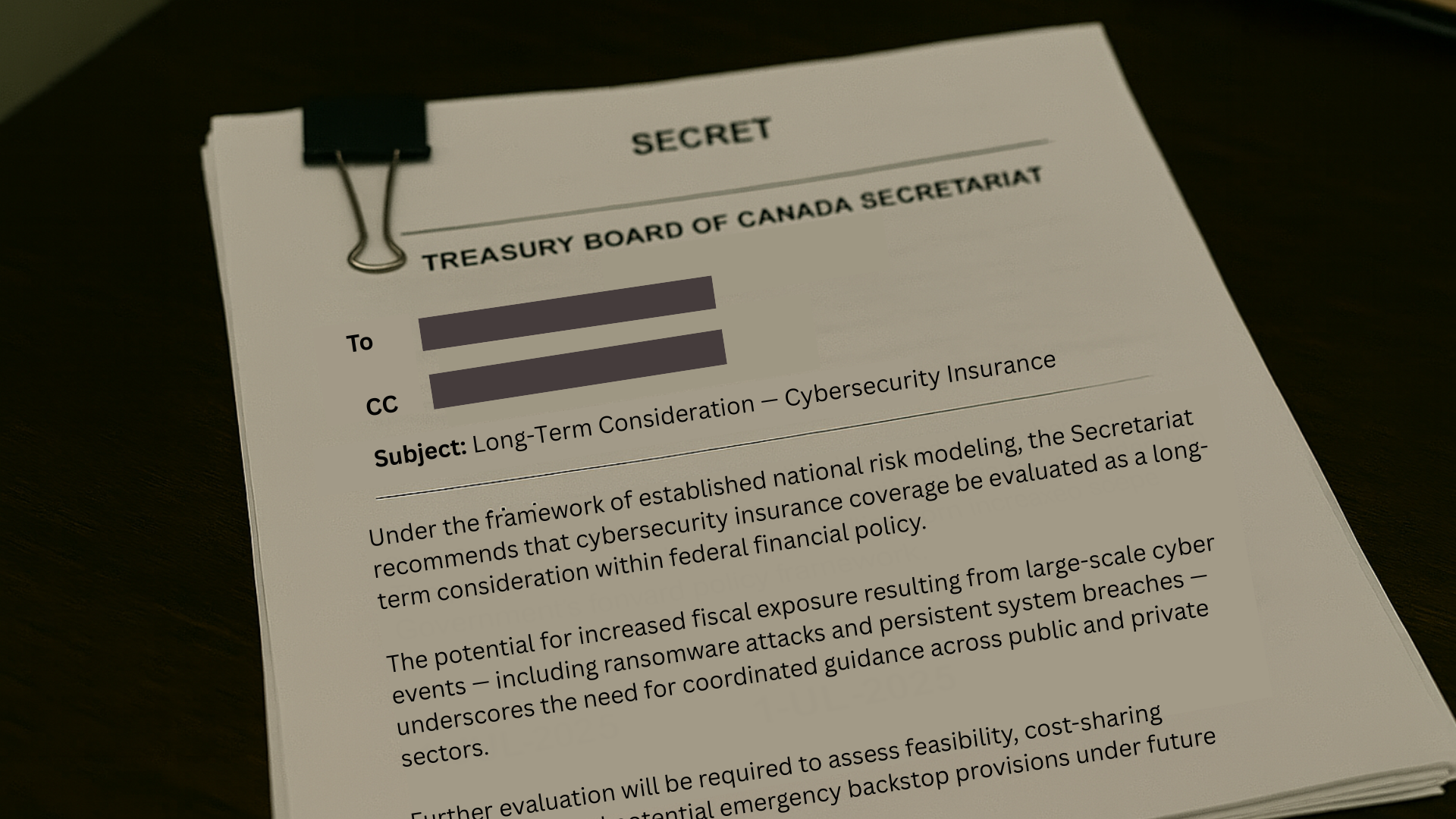
Government regulators have yet to propose a cyber insurance backstop or subsidy, though internal Treasury Board memos — leaked earlier this month — reportedly cite it as a “long-term consideration” under national risk modeling.
Following the risk behind the ROI. — Leila Park










March 31, 2026 — Virtex Dynamics’ decision to replace its Layer 1 workforce with agentic AI models was, by most internal measures, a success.
Operational efficiency improved within weeks. Ticket resolution times dropped. Workflows that once required manual triage and escalation were handled autonomously, with AI systems classifying, responding, and routing issues at scale.
The move aligned with a broader shift already underway across industries. Employees are no longer expected to simply perform their roles, they are expected to optimize them, often through artificial intelligence. At Virtex, that expectation became operational reality.
Layer 1 analysts traditionally responsible for intake, triage, and early-stage investigation were among the first to be impacted. Their responsibilities were absorbed by agentic systems designed to replicate decision-making pathways and execute tasks with greater speed and consistency.
For a time, the transition appeared seamless. There was no immediate disruption. No system failure. No identifiable breach. But over time, something began to surface… not as an incident, but as a pattern.
According to sources familiar with the internal review, Virtex began observing an increase in low-confidence anomalies: events that did not trigger alerts, but also did not fully resolve. Minor irregularities in user behavior, subtle deviations in system interactions, and edge-case requests that were processed without escalation.
Individually, these events carried little significance. Collectively, they suggested a blind spot.
Before the restructuring, these signals would have passed through Layer 1 analysts — individuals trained not just to process inputs, but to question them. Their role extended beyond execution. They provided context, skepticism, and early-stage interpretation.
Agentic systems, by contrast, operated as designed. They processed known patterns efficiently and escalated defined exceptions. What they did not do was challenge ambiguity.
As a result, a category of activity emerged that sat between normal operations and actionable alerts, neither disruptive enough to trigger intervention, nor routine enough to be fully understood.
The gap was not in capability. It was in judgment.
Security experts increasingly point to this as a defining risk in AI-driven environments. As organizations optimize for speed and throughput, the systems in place become highly effective at handling the expected but less capable of interpreting the uncertain. This creates conditions for what some describe as “false operational confidence,” where performance metrics indicate stability, even as visibility into edge-case activity declines.
At Virtex, the issue has prompted internal reassessment, but not reversal.
In an interview following the review, the company’s Chief Information Security Officer, Vikram Verona, emphasized that the organization remains committed to its AI-driven transformation.
“The productivity gains are real, and they are necessary,” Verona said. “The volume and velocity of what we’re dealing with today make traditional models unsustainable.”
When asked directly about the observed gap, Verona acknowledged the challenge.
“What we replaced was execution,” he said. “What we’re now addressing is interpretation. Those are not the same thing.”
Virtex is currently evaluating adjustments to its model, including the introduction of targeted human oversight at specific decision points, rather than a return to fully staffed Layer 1 operations.
“The objective isn’t to go backwards,” Verona added. “It’s to define where human judgment is still required, and ensure it’s applied where it has the most impact.”
The situation reflects a broader transformation taking place across the modern workplace. AI is no longer an experimental tool, it is becoming a baseline expectation, reshaping how work is performed and how performance is measured. In that environment, roles that cannot match the speed and scale of automated systems are increasingly under pressure. But as Virtex’s experience illustrates, the removal of those roles may also remove something less visible and more difficult to replace.
Not process. Not output. But the ability to recognize when something doesn’t quite fit. The risk is not that systems will fail. It is that they will continue to function exactly as intended while missing what they were never designed to see.
Following the risk behind the ROI. — Leila Park

A newly observed cyber technique is raising concern among analysts after several small and medium-sized businesses (SMBs) reported cascading operational errors without any single system breach, malware infection, or obvious scam trigger.
The pattern, now being informally described as an “AI-induced operational drift” attack, does not rely on traditional phishing, voice impersonation, or direct financial fraud. Instead, it exploits how SMBs coordinate work across email, messaging platforms, shared documents, and scheduling tools.
In reported cases, attackers used AI-generated messages to subtly alter internal workflows over several days. Employees received routine-looking updates that appeared to come from trusted colleagues: minor deadline changes, revised procedures, updated vendor instructions, or altered approval paths.
Individually, none of the messages appeared malicious. Collectively, they introduced confusion.
According to analysts, the technique begins with AI systems trained on publicly available company information, job postings, social media content, and leaked communication styles common within specific industries. Rather than asking for money or access, the messages focus on process.
Over time, teams begin working from different assumptions. Approvals slow, tasks are duplicated, and accountability becomes unclear.
“The goal isn’t to steal immediately,” one analyst said. “It’s to destabilize decision-making until mistakes become inevitable.”
SMBs often operate with lean teams and informal communication norms. Processes evolve quickly, and documentation may lag behind reality. This makes it difficult to distinguish legitimate operational changes from manipulation especially when messages sound like they came from inside the organization.
Unlike larger enterprises, SMBs may not log or audit internal process changes with the same rigor, allowing AI-generated misinformation to persist unnoticed.
In some cases, the operational drift eventually led to missed payments, contractual breaches, or internal disputes, consequences that appeared self-inflicted rather than malicious.
Security experts warn that this technique represents a shift from event-based attacks to environmental manipulation. There is no single moment of compromise, no obvious alert, and no clean incident timeline.
“This isn’t about breaking systems,” one advisor noted. “It’s about quietly reshaping how people work until the organization breaks itself.”
Because the activity blends into normal business communication, traditional security tools often fail to detect it. The damage only becomes visible after trust and coordination have already eroded.
Analysts say defending against this class of threat will require organizations to rethink assumptions about internal communication. Verification, change management discipline, and clarity around decision authority are becoming as important as technical controls.
As AI continues to advance, experts caution that the most dangerous attacks may not arrive as alarms or outages.
They may arrive as helpful messages, reasonable suggestions, and small changes slowly steering organizations off course.
For SMBs, the challenge ahead is not just protecting systems, but protecting shared understanding itself.
Following the risk behind the ROI. — Leila Park

November 11, 2025 — Monday’s unexpected disruption across Canada’s banking and transit systems has raised new questions about how vulnerable the country’s digital backbone has become to invisible faults, and how easily precision can unravel at scale.
For nearly six hours, payment terminals, trading systems, and commuter networks were thrown into chaos after a timing fault aboard a SkyGrid Communications satellite sent inaccurate synchronization signals to ground-based systems. The result: frozen transactions, halted trades, and locked transit gates across major cities.
From Vancouver’s transit cards to Toronto’s stock exchange, the pattern was clear — infrastructure that once seemed distinct now depends on the same unseen heartbeat pulsing from orbit. When that heartbeat falters, the whole system stumbles.
“It’s astonishing how much of modern life runs on the assumption that time is perfect,” said Dr. Amira Doucette, a cybersecurity researcher at Laurentian University. “When your clocks drift, your trust drifts. Every financial ledger, every secure transaction — it all breaks down.”
The incident began around 9:14 a.m. Monday, when banks, telecom carriers, and public transit systems started reporting timestamp errors. While SkyGrid initially described it as a “configuration anomaly,” federal investigators are not ruling out the possibility of deliberate interference.
“This wasn’t an outage you could see,” said a senior government analyst familiar with the investigation. “It was silence — and in that silence, everything froze.”
By mid-afternoon, synchronization was restored, and queued transactions began replaying. But experts say the episode exposed just how fragile Canada’s digitized economy has become. A single orbital fault managed to slow millions of micro-interactions across sectors, revealing the extent to which precision timekeeping underpins the nation’s trust infrastructure.
Some officials privately compared the event to cyber-operations seen abroad — where technical disruptions are used to mask deeper intrusions or manipulate public confidence. Though SkyGrid maintains there’s no evidence of compromise, the cascading nature of the failure has left analysts uneasy.
“This is the modern equivalent of a power outage,” said Michael Gervais, a former CSE official. “Except now, it’s not the lights that go dark — it’s the systems that decide what’s true, secure, and synchronized.”
A post-incident review is underway involving the Canadian Space Agency, Public Safety Canada, and the CSE, examining why redundant ground links failed to take over and whether the anomaly was purely technical.
For most Canadians, the disruption was temporary — a few failed payments, a stalled subway gate, a flickering stock ticker. But for those watching closely, it marked something bigger: the moment a nation glimpsed how its digital world could falter not from an attack or storm, but from a second of silence above the clouds.
Following the risk behind the ROI. — Leila Park
ODTN News’ Ayaan Chowdhury contributed to this report.


Canadian Startup Unveils Wearable AI Assistant for Real-Time Transcription and Summaries

Popular Messaging App Glitch Briefly Exposes User Accounts During System Update

Federal Bill Mandates Early AI Integration in Schools

Reddit Thread Over ‘Inventory Drift’ Surges as Canadians Vent Over Retail Glitches

Are Canadian Companies Learning from Global Cyber Attacks? Insider Insights into the Secret Downfall of Canadian Businesses

Calgary Small Business Hit by Sudden Payment Outage, Sparks Cybersecurity Concerns
-
 Public11 months ago
Reddit Thread Over ‘Inventory Drift’ Surges as Canadians Vent Over Retail Glitches
-
 Business11 months ago
Are Canadian Companies Learning from Global Cyber Attacks? Insider Insights into the Secret Downfall of Canadian Businesses
-
 Retail Watch10 months ago
Calgary Small Business Hit by Sudden Payment Outage, Sparks Cybersecurity Concerns
-

 Cybersecurity12 months ago
Canadian Airline NorthSky Faces Cyberattack, Disrupting Online Services
-

 Business1 year ago
Canadian Software Vendor Breach Exposes Cloud Environments Across Energy Sector
-
 Business9 months ago
siberX Mart Supply Chain Snarled as Digital Transformation Faces Cyber Threats
-
 Politics10 months ago
Nationwide Government System Outage Paralyzes Public Services
-

 Retail Watch11 months ago
Understaffed and overwhelmed, IT teams face rising pressure as retail digitization accelerates